
SPECTROSCOPY SYSTEMS:
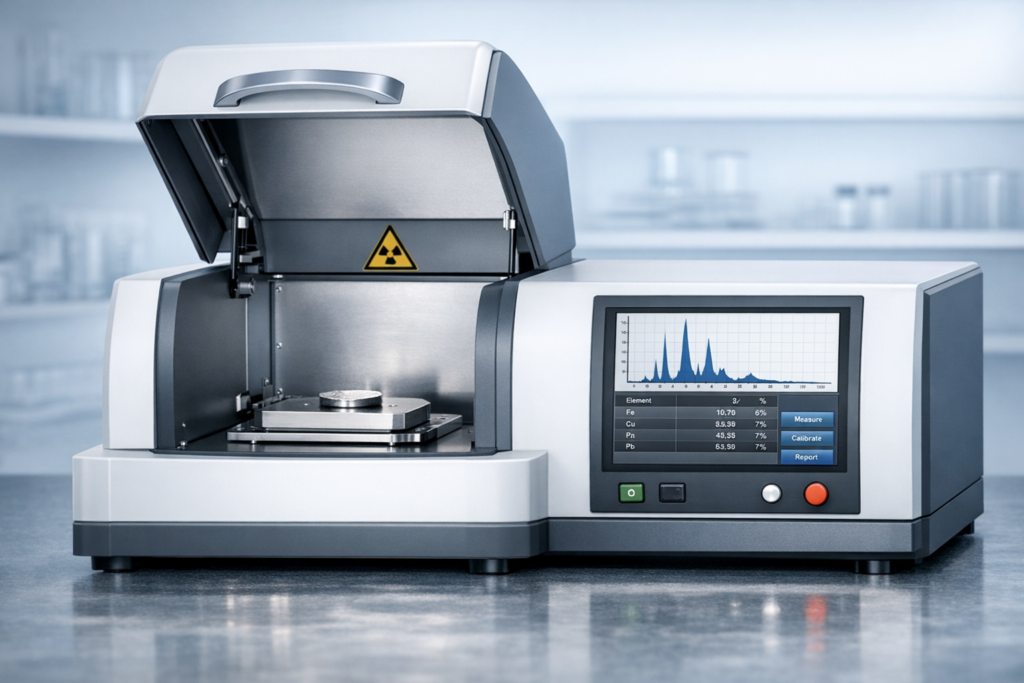
XRF - Spectrometer
Principle:
X-ray Fluorescence (XRF) works on the principle that when a material is irradiated with high-energy X-rays, its atoms emit secondary (fluorescent) X-rays that are characteristic of the elements present. By measuring the energy and intensity of these emitted X-rays, the elemental composition of the sample can be identified and quantified.
Key Features of XRF:
• Non-destructive: The sample remains intact, making it ideal for valuable or rare materials.
• Versatile: Works on solids, liquids, and powders with minimal preparation.
• Elemental range: Detects elements from sodium (Na) to uranium (U), instrument configuration.
• Quantitative & qualitative: Provides both identification and concentration of elements.
• Versatile: Works on solids, liquids, and powders with minimal preparation.
• Elemental range: Detects elements from sodium (Na) to uranium (U), instrument configuration.
• Quantitative & qualitative: Provides both identification and concentration of elements.
Types of XRF:
• Energy Dispersive XRF (EDXRF)
• Wavelength Dispersive XRF (WDXRF)
• Micro-XRF
• Wavelength Dispersive XRF (WDXRF)
• Micro-XRF
Applications:
• Geology & Mining
• Environmental Science
• Metal & Alloy Analysis
• Pharmaceutical Industry
• Archaeology & Art
• Cement & Construction Materials
• Petroleum & Petrochemicals
• Food & Agriculture
• Forensic Science
• Jewelry & Precious Metals
• Environmental Science
• Metal & Alloy Analysis
• Pharmaceutical Industry
• Archaeology & Art
• Cement & Construction Materials
• Petroleum & Petrochemicals
• Food & Agriculture
• Forensic Science
• Jewelry & Precious Metals
Ready to Work With Podhikai Scientific?
Take the next step in strengthening your laboratory or research facility with
reliable scientific instruments. Contact us to discuss your requirements or
learn more about our solutions.